'Unbreakable Healer': New book tells forgotten story of pioneering Palm Beach County doctor who risked her life overseas to save thousands
Author Ginger Pedersen will discuss Dr. Mabel E. Elliott's life at free lectures Wednesday in West Palm Beach, Thursday in Lake Worth Beach and Nov. 24 in Boynton Beach.

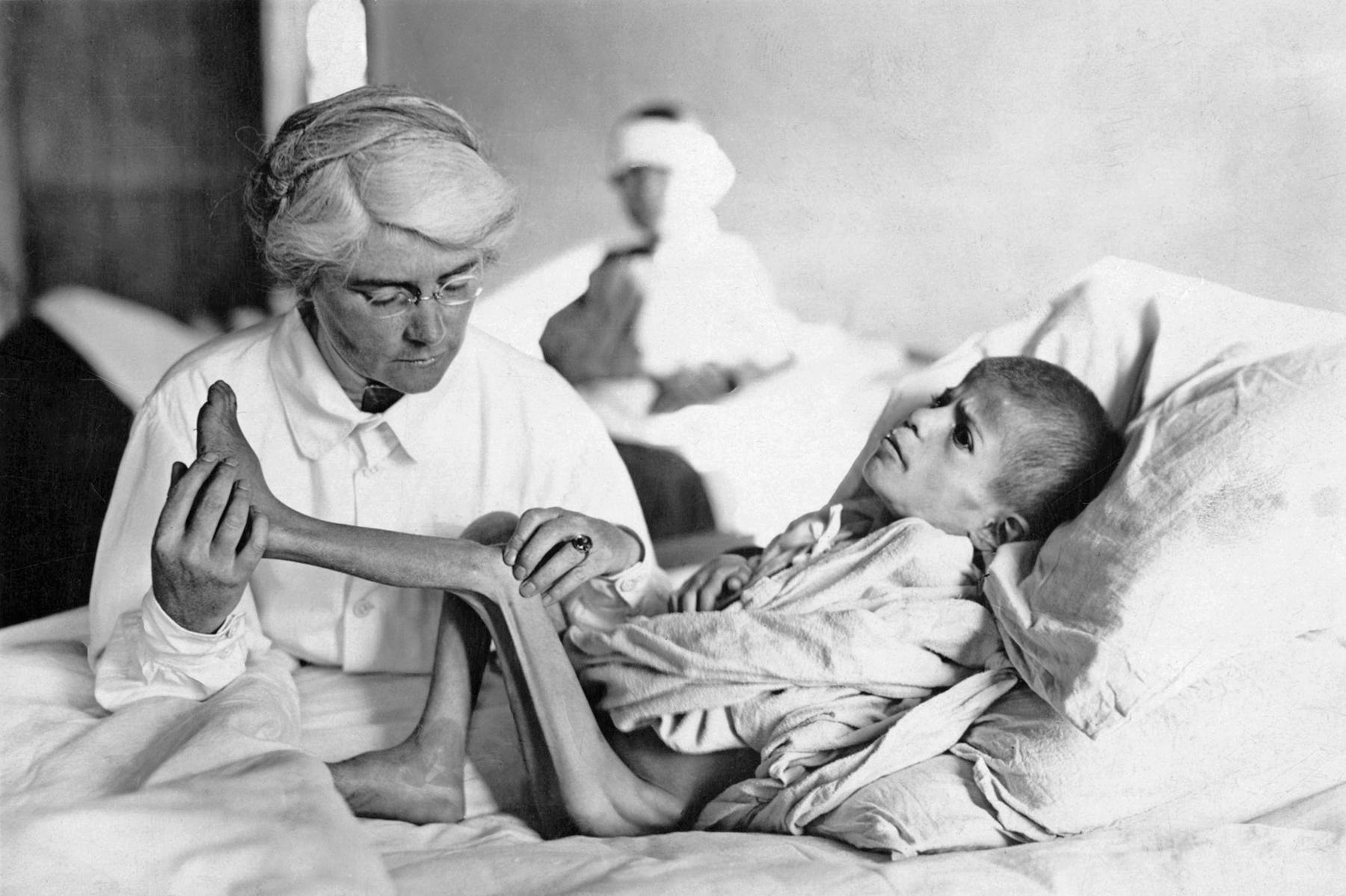
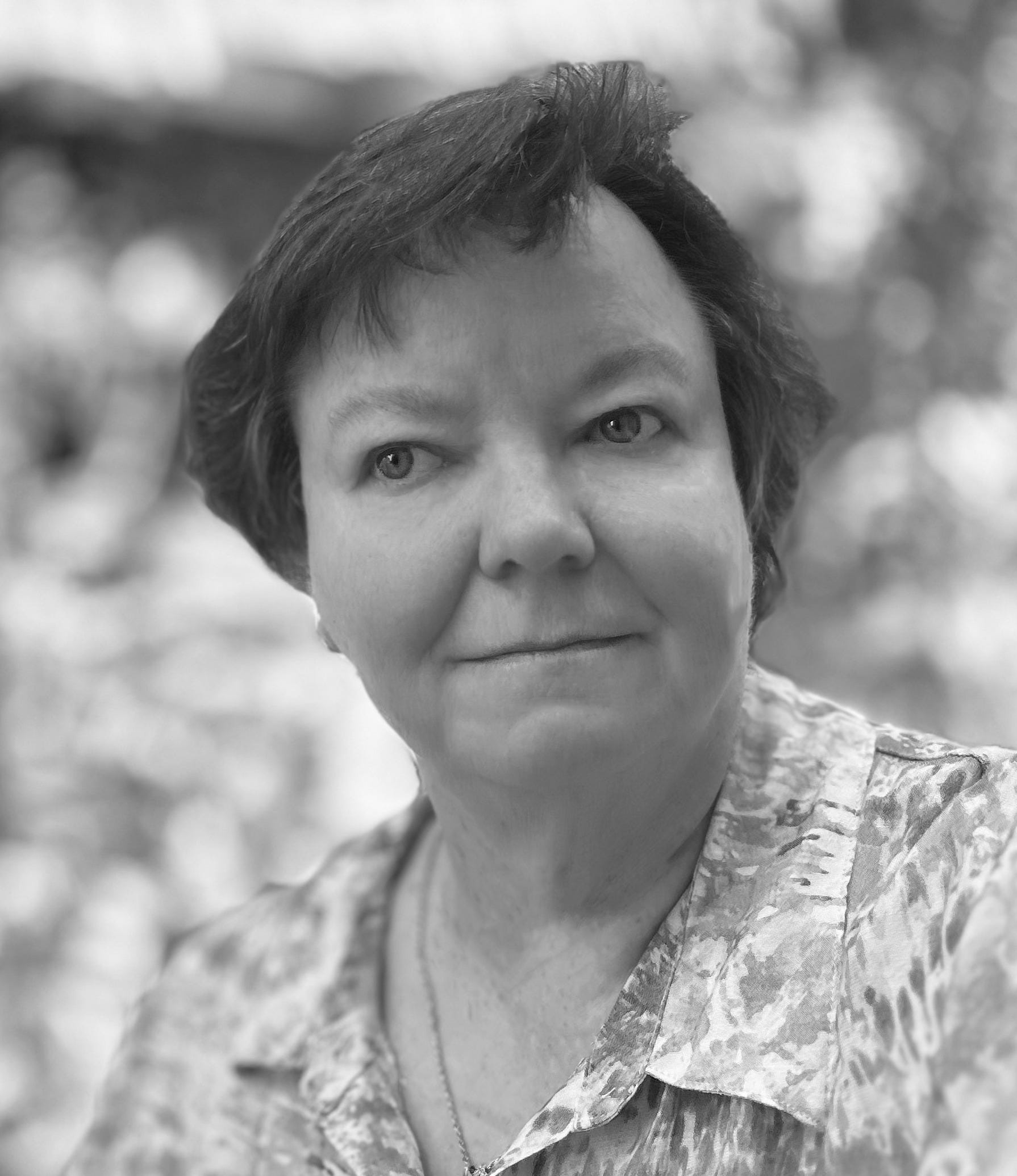
Author Ginger L. Pedersen never imagined that a casual scroll on Facebook could inspire a book.
One day in 2018, the Boynton Beach writer came across a post on the “Palm Beaches Remembered” page mentioning a name she was not familiar with — Dr. Mabel Elliott.
“She died in 1968,’’ the writer of the post, Mike Welbourn, wrote, “but as a child I knew her because she lived in our cottage on Greenwood Dr. At the time, about all I knew about her was that she saved my fathers(sic) life when he was a child in Japan in the mid-1920s. Little did I know of the amazing life she led.’’
Pedersen was intrigued. Eventually, she got around to scouring newspaper archives, studying Elliott’s academic archives and tracking down the late physician’s relatives who gave access to Elliott’s diaries, letters and photo albums.
What emerged was a compelling story about a pioneering physician and medical missionary from West Palm Beach who saved thousands of lives while bearing witness to some of the 20th century’s greatest humanitarian crises.
When Elliott wasn’t spending time with family in Palm Beach County, she went overseas to care for thousands of Armenian and Greek refugees through bullets, blizzards, and deadly disease after World War I.
“I was so unbelievably, I guess I would use the word, touched by what I was reading,’’ Pedersen said, “and what puzzled me more than anything is how this story was never told before.’’
Pedersen, author of four other Palm Beach County history books, knew it was up to her to tell it.
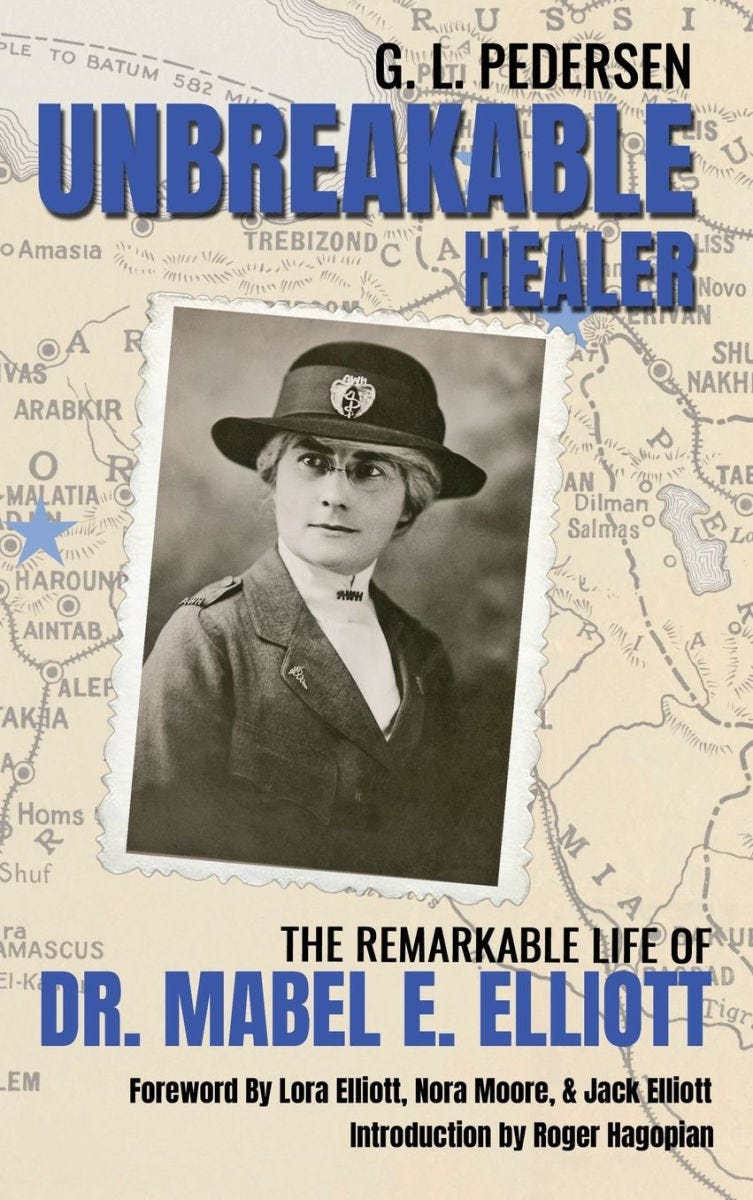
“Unbreakable Healer: The Remarkable Life of Dr. Mabel E. Elliott,’’ published in September by Palmango Press, is “really a hero’s story in many ways. What she endured and what she saw, it’s pretty incredible. I sometimes wonder why she didn’t just go stark raving mad,’’ Pedersen said.
“After all my research, one truth rang clear: She was unbreakable. And so, the book named itself.’’
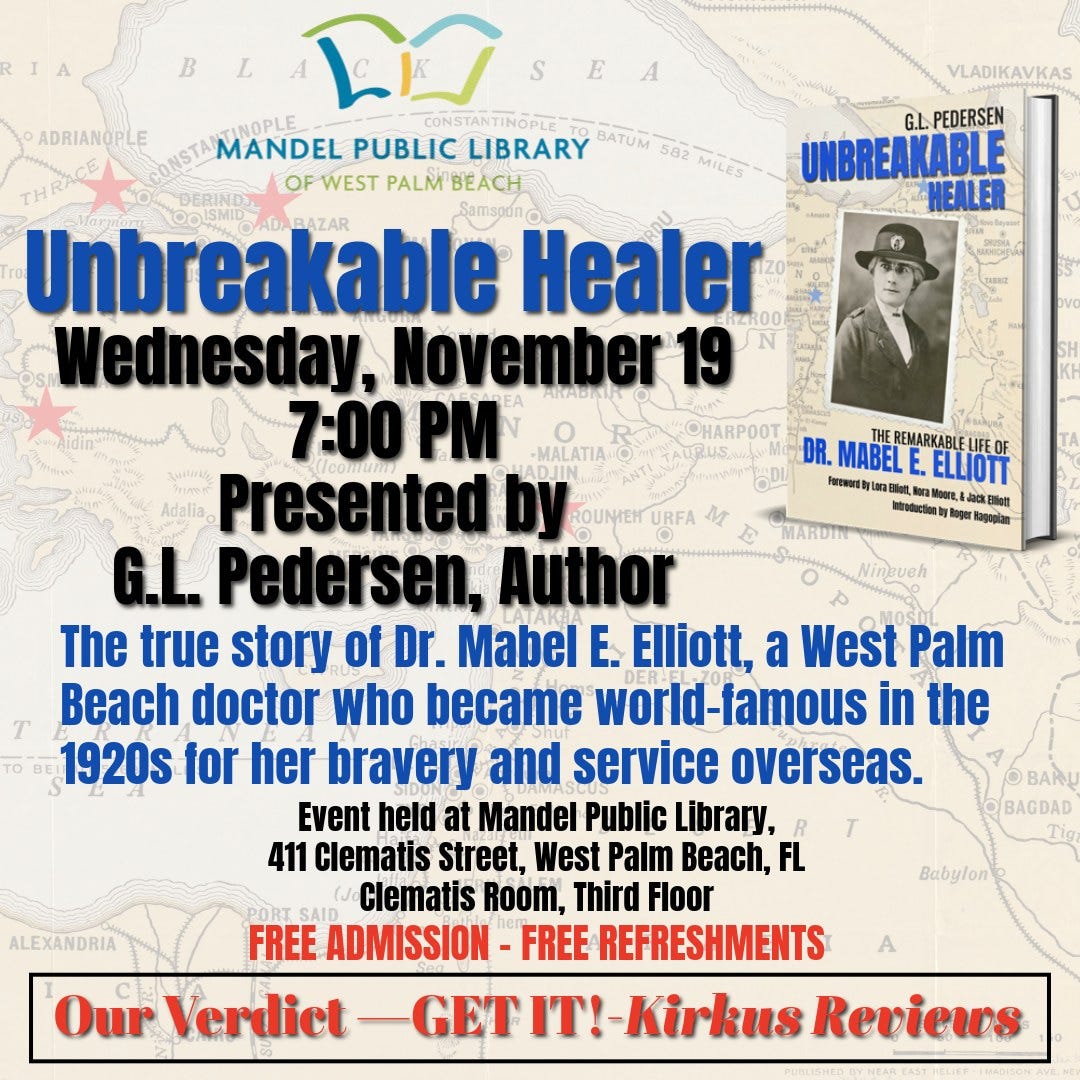
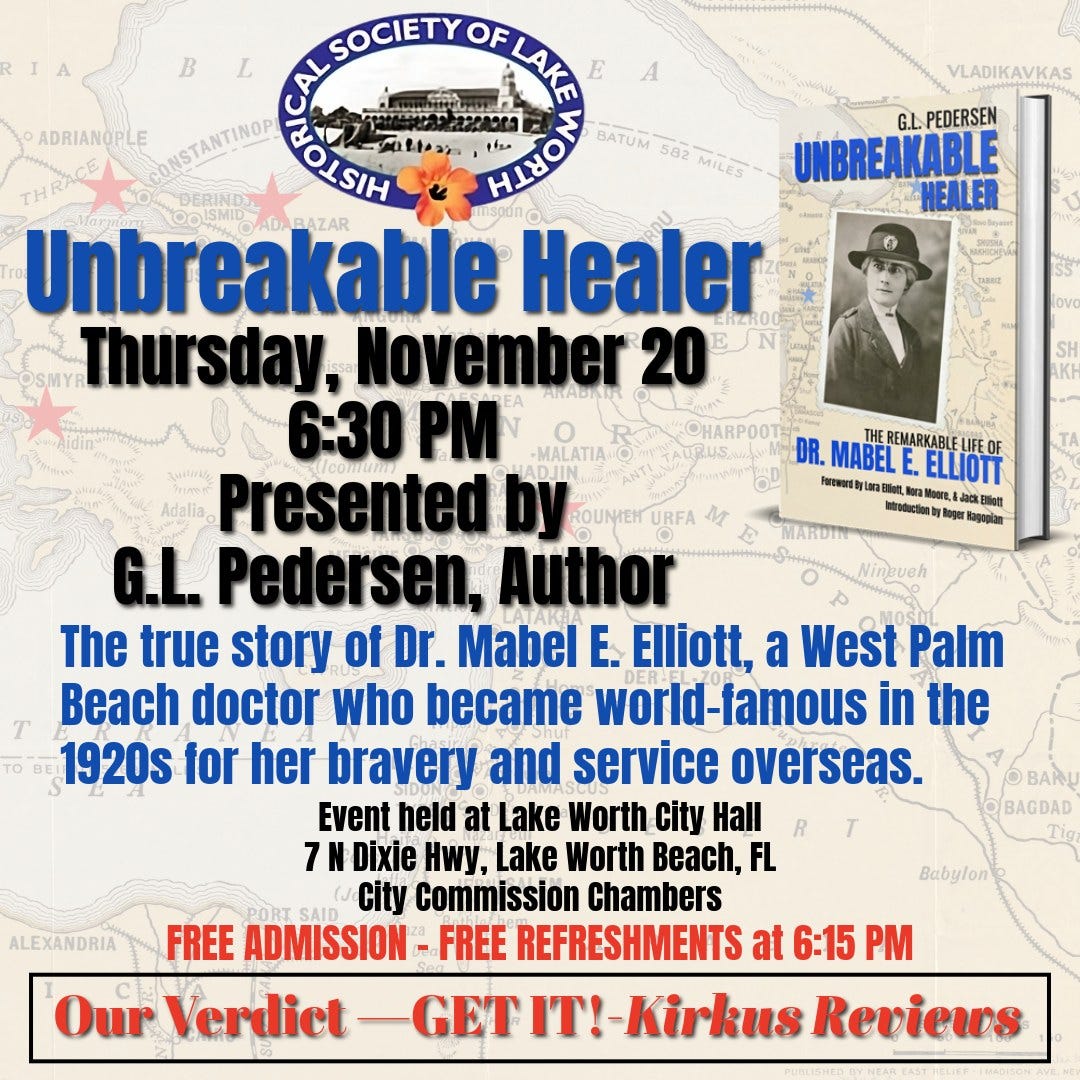
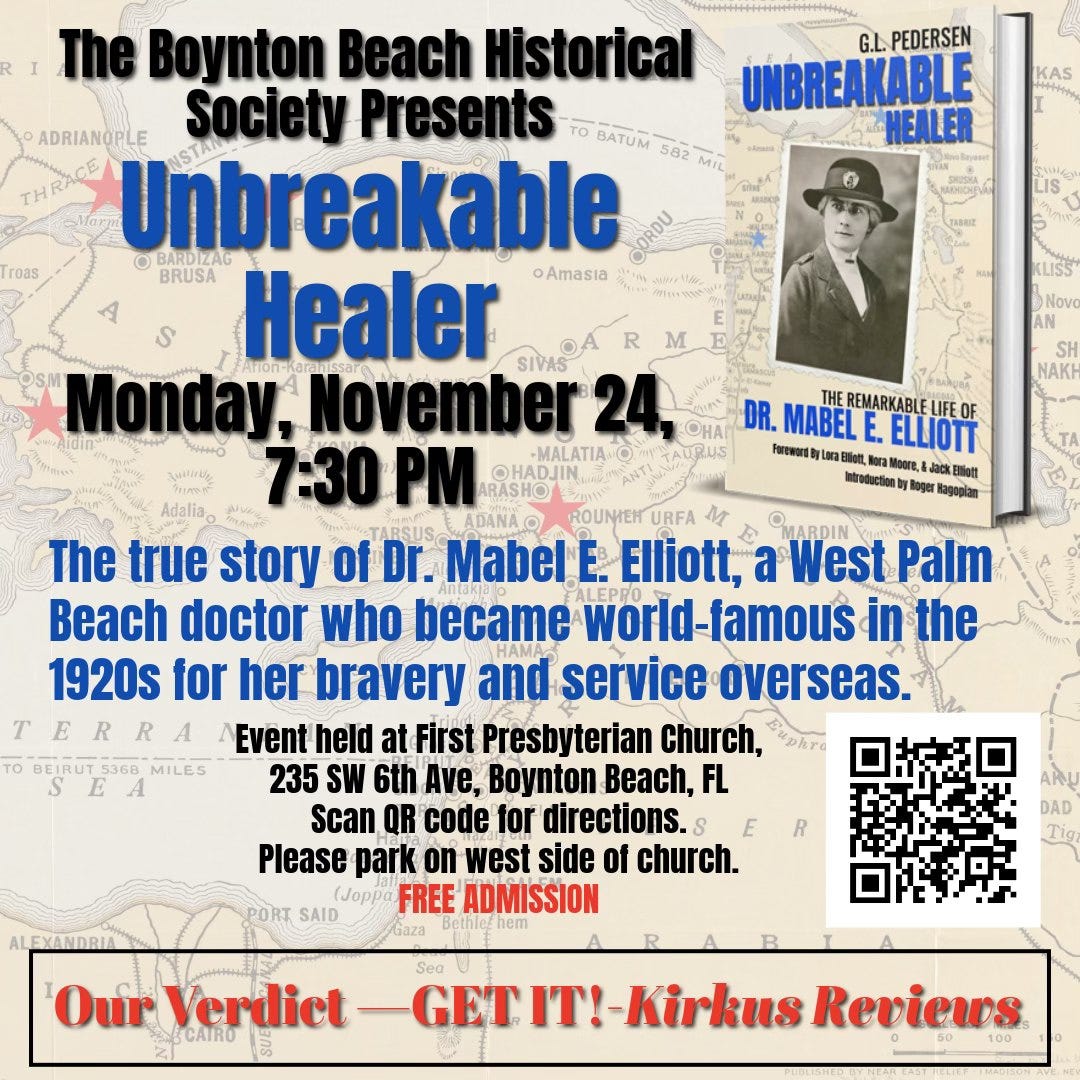
Pedersen will share her insight into Elliott, often called the Florence Nightingale of her time, at three lectures starting this week. The free lectures are:
Nov. 19 at 7 p.m., the Mandel Public Library, 411 Clematis St., West Palm Beach.
Nov. 20 at 6:30 p.m., Lake Worth Beach City Hall, 7 N. Dixie Hwy., presented by Historical Society of Lake Worth Beach.
Nov. 24 at 7:30 p.m., First Presbyterian Church, 235 SW 6th Ave., Boynton Beach, presented by Boynton Beach Historical Society.
Born in England, Elliott was 13 when she arrived in West Palm Beach in 1894.
A year earlier, her father, Joe Elliott, came to town to run the commissary for the workers building Henry Flagler’s railroad and the Royal Poinciana Hotel.
The family built one of the newly-incorporated town’s earliest homes, on Datura Street next to the present-day Meyer Amphitheater. Joe Elliott, who chaired a committee that helped form West Palm Beach in 1894, ran for mayor that year and lost by two votes.
In 1914, he bought a small hotel in Lake Worth, at the site of the present-day Dollar General store, and renamed it the Hotel Florida. (The old hotel was demolished during the 1984 Paul Newman movie Harry & Son.) His son, Joe Jr., helped develop the Lake Worth Casino, Pedersen said.
Mabel Elliott, one of 14 siblings, knew she “wanted to be a doctor early on,’’ Pedersen said. After moving to Albany, N.Y., to be with her oldest sister, Grace, they both graduated high school and enrolled at Chicago’s Rush Medical College, which had just started admitting women. The sisters graduated together in 1904.
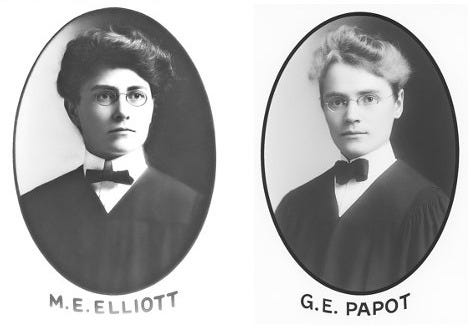
Mabel went into practice in Benton Harbor, Mich., and was elected president of the Berrien County Medical Association in 1915. She made frequent cross-country automobile drives with her sisters and friends to see family in Lake Worth and West Palm Beach.
When World War I broke out, she volunteered to serve with the Red Cross in France, but the hostilities ended before she could get her passport. At the request of the American Woman’s Hospitals, she went to the region of Turkey, Greece and Armenia to offer aid to disease-ridden and starving survivors of the Armenian Genocide.
She ran head-on into the Turkish revolution. For three weeks in early 1920, Elliott and her staff worked in a hospital under siege during the Battle of Marash. “How she survived without being shot in the Battle of Marash was something that puzzled even her,’’ Pedersen said.
When the French decided to retreat, Elliott faced a difficult decision — leave with the French for her own safety or stay to help her Armenian staff survive. She stayed and led her staff on a perilous journey over the Taurus Mountains in southern Turkey, enduring a blizzard that killed many refugees.
Once they reached safety, Elliott arranged travel for two nurses to America before she herself returned home. She shared her ordeal with The Palm Beach Post later that spring.

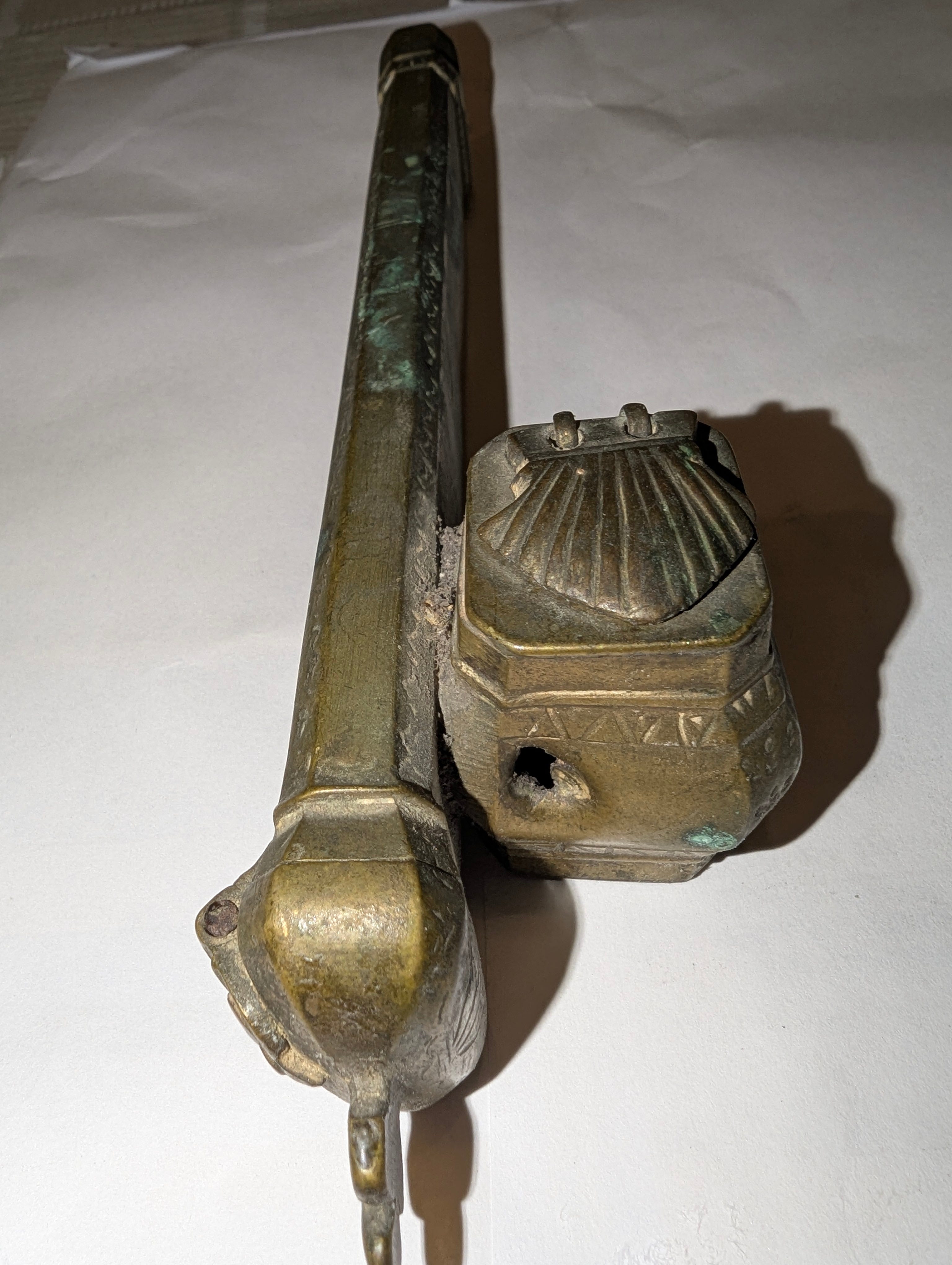
Four months later, she returned to the Near East to offer medical aid in Turkey, Armenia and Greece. In 1923, Elliott was the first woman to be awarded the Greek War Cross medal by the Greek government for her effort in saving and caring for the refugees.
She followed that with a tour of duty in earthquake-ravaged Japan. She transformed pediatric care and saved thousands of children through nutrition, well-baby clinics, and the introduction of preventative measures like the diphtheria vaccine.
After 16 years, she left Japan in late 1941, just weeks before the bombing of Pearl Harbor. Returning to West Palm Beach, she bought a house on Westwood Road, a few blocks north of Belvedere Road, where she lived with a sister. Mabel went to New York during World War II to examine missionaries going to and from Europe.
In the 1950s, she worked as a doctor at Penney Farms, a community near Jacksonville launched by the department store pioneer for retired Christian ministers.
Elliott died in 1968 at Good Samaritan Hospital in West Palm Beach at age 87.
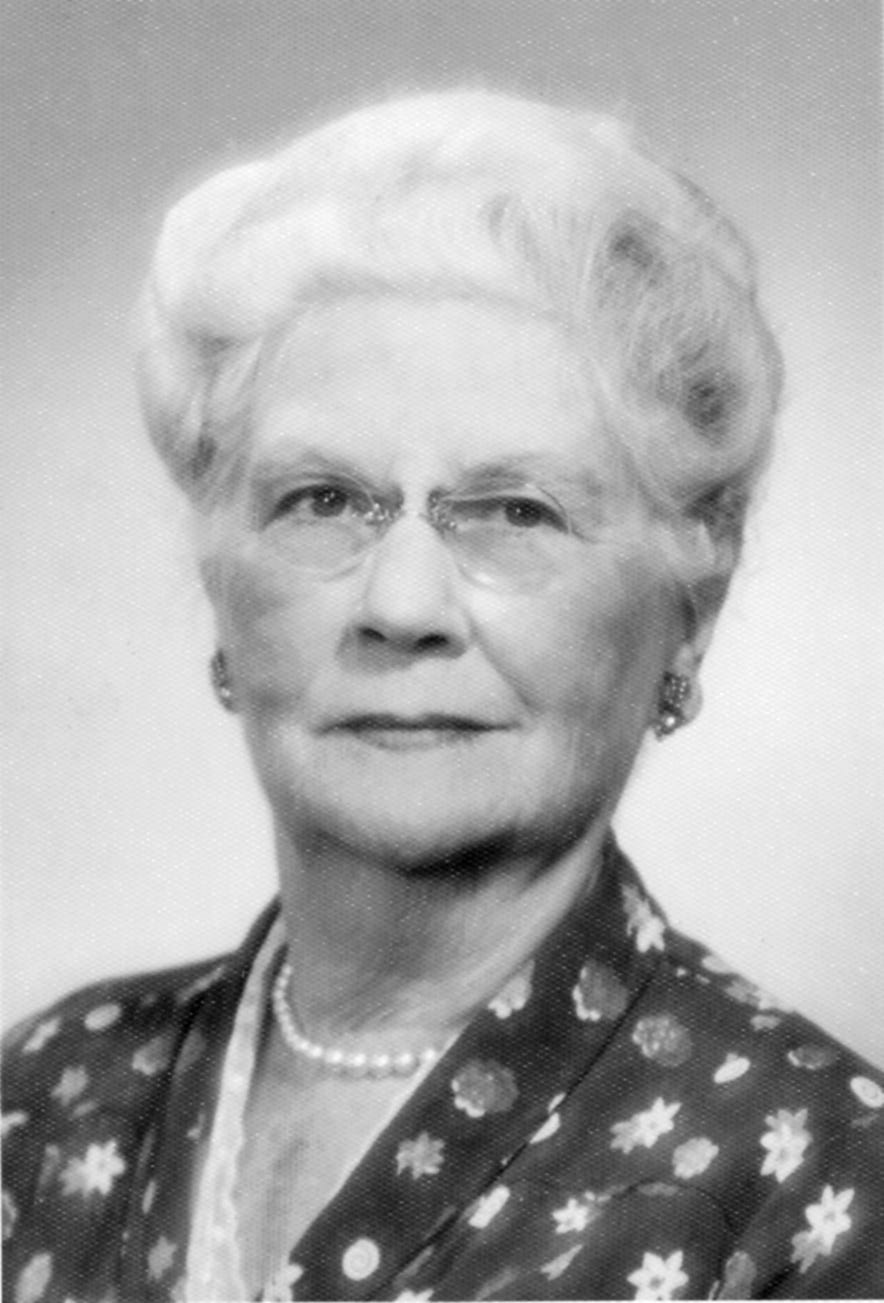
“She was by nature a very quiet leader and drew people in by her gentle nature,’’ said Pedersen, adding that she has started process with the Episcopal church to have Elliott considered for sainthood.
Among those Pedersen interviewed for “Unbreakable Healer” was Mike Welbourn, the man whose 2018 Facebook post inspired the book.
“I just knew her as the retired doctor who pulled a thorn out of my foot with a pair of rusty pliers,’’ he wrote in an Amazon review praising the book.
In 2024, Pedersen tracked down Elliott’s grand niece in Hobe Sound who helped her access family documents. When the grand niece told Pedersen that Elliott never married or had children, Pedersen offered a warm retort.
“I told her, ‘Wait a minute. Your great aunt had thousands of children, the thousands of children that she saved.’’’