
Outside Alligator Alcatraz, 'Father Frank' holds Mass for immigrant 'heroes'
Lake Worth Beach's Guatemalan Maya Center founder devotes Diamond Jubilee celebration to detainees

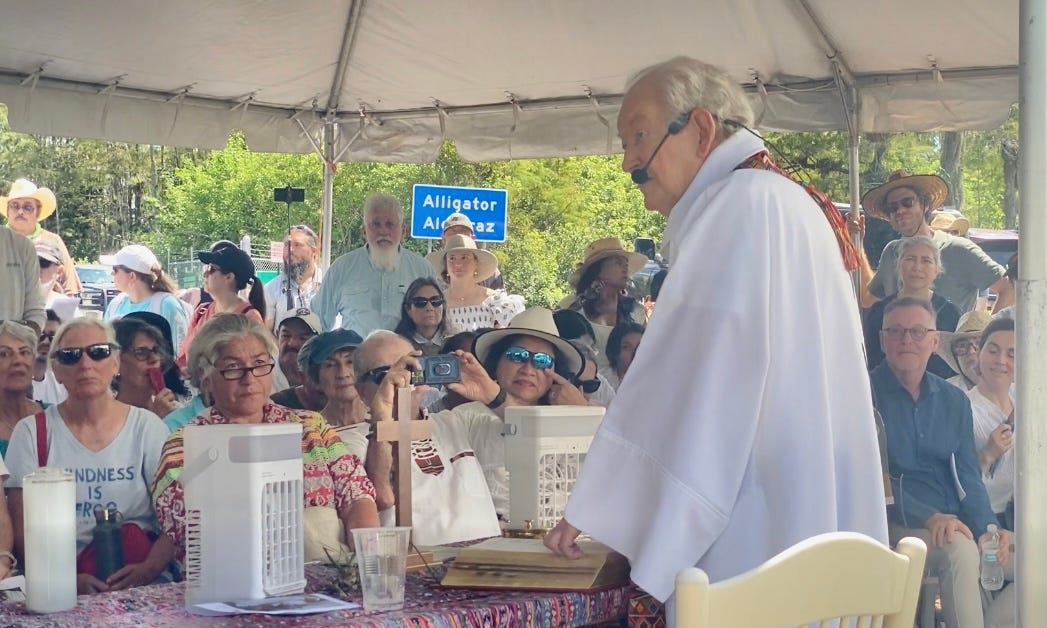
On the side of a road in the Florida Everglades, an 83-year-old priest from Ireland offered Mass on Saturday.
Nearly 130 people attended, including one from California and a dozen from Lake Worth Beach, including City Commissioner Christopher McVoy and former Commissioners Kim Stokes and Cara Jennings.
Fanning themselves with prayer booklets, they packed a makeshift temple, a white tent on the muddy edge of a swamp across from the entrance to the Alligator Alcatraz detention facility.
The hourlong service, in buggy 92-degree heat, was just the latest act of compassion from Father Frank O’Loughlin, founder of the Guatemalan Maya Center in Lake Worth Beach.
Despite his own physical limitations, he purposely chose the rugged location for his Diamond Jubilee Mass in a show of solidarity for the reported 700 people — he calls them “heroes” — detained at Alligator Alcatraz.
“We have been invited, Lord, to participate in the great crime of our times. Persist us with your strength,’’ he said, his frail voice occasionally drowned out by the roar of passing trucks a few yards away on Tamiami Trail.
“You send us to be your face, your countenance, your visibility in the company of the heroes who have come to take asylum among us,” he said. “So, maintain some confidence in one another as you charge us to go forth from here and be the face of your power and presence in the unfortunate episode through which this country is suffering.’’
Father Frank, as he’s known, has been advocating on behalf of immigrants and the marginalized for all of his 60 years as a priest. Saturday’s Mass served as an exclamation point on a career that started in 1965 when he arrived in suburban West Palm Beach, freshly ordained from All Hallows Seminary in Dublin.
Assigned to the Holy Name of Jesus Church on Military Trail, he earned the nickname “peace priest” for his Vietnam War sermons. He also encountered migrant farmworkers living in shacks in the Westgate neighborhood with no electricity or plumbing.
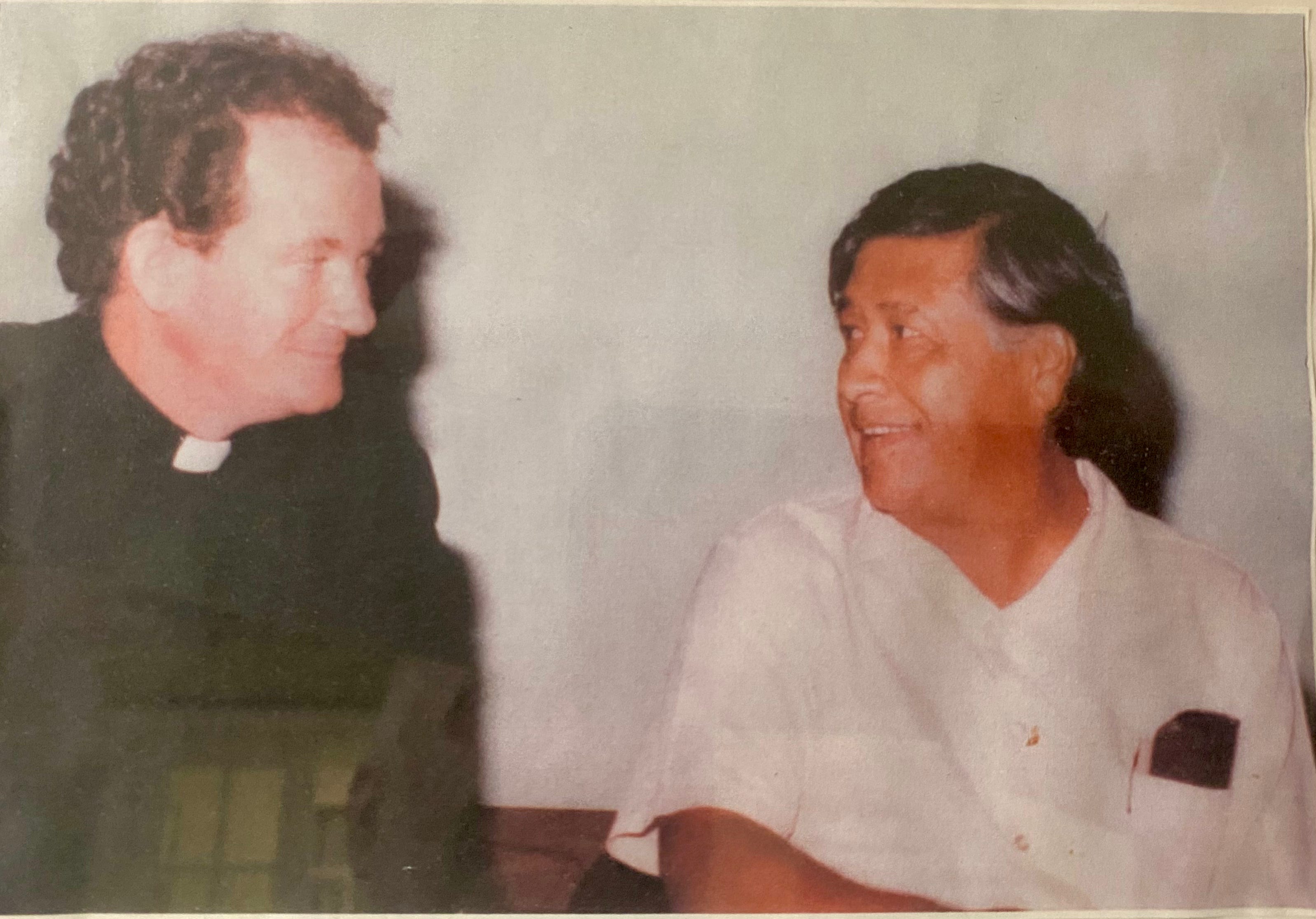
He knew he’d found his mission. He learned Spanish and Creole. He picketed with Cesar Chavez and the United Farm Workers in Miami on the grape and lettuce boycotts in the 1970s, helped launch the Hope Rural School for migrant children in Indiantown in 1980 and founded the Guatemalan-Maya Center in 1992.
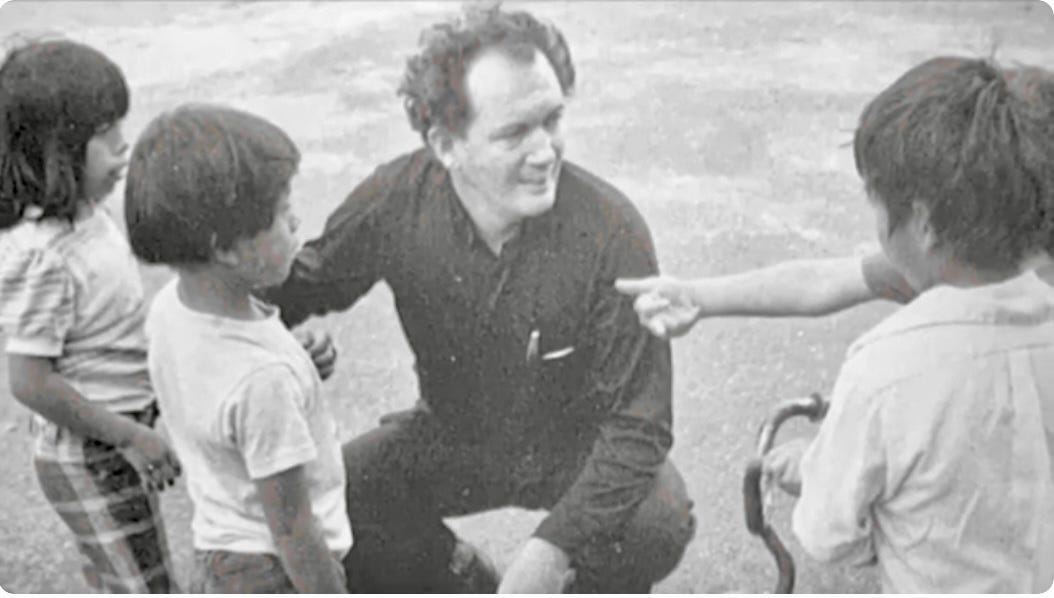
In his younger years, he was not afraid to crawl under fences and sneak into workers' barracks on citrus processing plants around Lake Okeechobee to hand out special prayer cards: On one side an image of Our Lady of Guadalupe, on the other, reminders, written in Spanish, about their legal rights.
He often went to Tallahassee and Washington to lobby on behalf of migrant farmworkers; he liked to hold court at The Dubliner, a Capital Hill watering hole popular with Beltway heavy hitters.
He’d receive phone calls from Florida Govs. Bob Graham and Lawton Chiles, who’d seek Father Frank’s counsel on issues. And he served as the plaintiff on behalf of the families of migrant workers killed in accidents and securing millions of dollars in life-changing money.
“There is no doubt in my mind that the quality of the lives of the immigration population in South Florida has been dramatically improved as a consequence of Father Frank’s advocacy,’’ said attorney Jack Scarola, whose law firm helped O’Loughlin with lawsuits.
Scarola, who got to know Father Frank at the Cathedral of St. Ignatius Loyola in Palm Beach Gardens, made the journey Saturday and read a prayer during the Mass.
Another attendee, Jerry Kay, 78, traveled from Santa Cruz, Calif., to reconnect with the Father Frank he first met in the lettuce and grape boycotts in the 1970s. They stayed in touch by phone, including a call last month when the priest told Kay about the Everglades Mass.
“When he told me about this, I said ‘I’m going down there,’’’ Kay said as he stood outside the tent. “I hadn’t seen him in 30 years. There's something about his spirit that just overwhelms us all.’’
With help from friends and associates, Father Frank was able to arrange the Mass in what has been a busy summer. Two weeks ago, he traveled back to Ireland for a pre-arranged Diamond Jubilee celebration at All Hallows.
In June, when the detention center went up in just one week on an airstrip in Big Cypress National Preserve, he said he knew he had to shift the focus of his 60-year anniversary.
The state-built facility has been a focal point of President Donald Trump’s crackdown on undocumented residents, including raids last week in Lake Worth Beach.
“What is happening is inconceivable. The USA, the America that we all have known, this is all utterly inconceivable,’’ O’Loughlin said in an interview a few days before his Everglades Mass. “Could there be a bigger tragedy for the United States?’
He has been even more blunt with others. Mariana Blanco, assistant director at the Guatemalan Maya Center, recalled a recent conversation Father Frank had with an immigration attorney.
“Father Frank said to him, ‘In all my years of doing this work, this is the worst it has ever been,’’’ she said. “That really deflated me because, man, if Father Frank is saying something like that, it really carries a lot of weight.’’
When he started planning his local Diamond Jubilee celebration, “he felt it was necessary to stand in solidarity with our brothers and sisters currently detained in the facility across the street,’’ Blanco said to the crowd.
Those close to him worry about his health. The priest with the good metaphorical heart has a bad biological one.
He suffered heart attacks in 1985 and ‘86, and a stroke in 2020. He has had multiple stints in intensive care. He uses a wheelchair to travel long distances but tries to get by without one, usually by holding someone’s elbow or hand.
Father Frank downplays those concerns. He offers a reminder that he held a prayer service outside Alligator Alcatraz in July and did just fine in the South Florida heat.
“I'm an old Florida boy,’’ the Irishman said with a smile.
As for concerns about his health, he said, “I owe a considerable debt to American medicine.’’
Then he taps his sense of humor and recalls how friends, after his heart attacks in the 1980s, often asked “about my near-death experience. I would always tell them, ‘My near-death experience was that I almost became an accountant.’’’
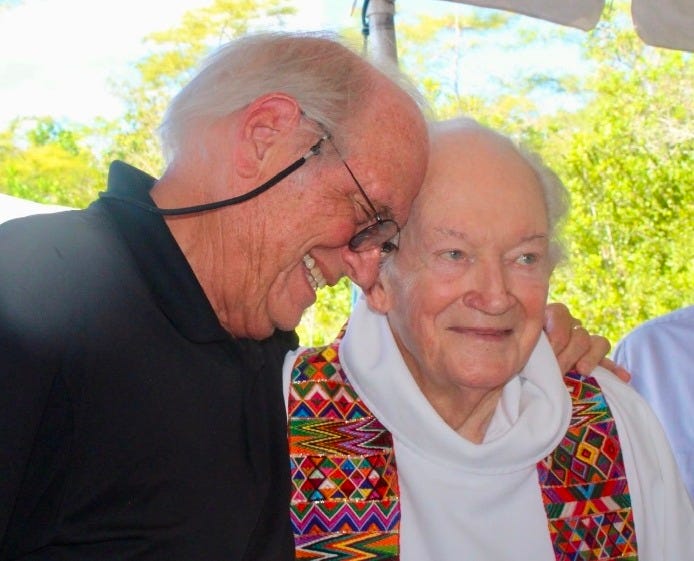
True story, said O’Loughlin, the eldest of six siblings raised by a dairyman and a teacher in Ennistymon, Ireland, a few miles from the Atlantic coast.
One day in the final weeks of his senior year, an accounting firm came to the high school to recruit students. They offered to pay Henry Francis O’Loughlin’s tuition at University College in Dublin.
He said he agreed to it but on one condition: He first wanted to explore the priesthood, “a notion” he'd had written about years earlier in a student essay.
When he was ordained in 1965, he answered a call from a fellow Clare County, Ireland, priest in Fort Lauderdale who was looking for help in South Florida. He arrived later that year in suburban West Palm Beach.
He likes to point out that he’s just the latest in a long line of All Hallows priests to make their mark in Florida. The tradition started, he said, in the 1850s when the Dublin seminary sent a priest to an island west of Key West to minister Irish laborers recruited from Philadelphia to help build Fort Jefferson in what is now Dry Tortugas National Park.
“All Hallows was founded so priests would accompany the immigrants who were going around the world,’’ he said. “Where they went, we followed.’’
Saturday wasn’t the first time Father Frank prayed outside a detention facility.
Years ago, he held a vigil in Homestead, where “they could hear me on the other side of the fence,’’ he said.
“Out here,’’ he said, referring to Alligator Alcatarz, “they are a mile away.’’
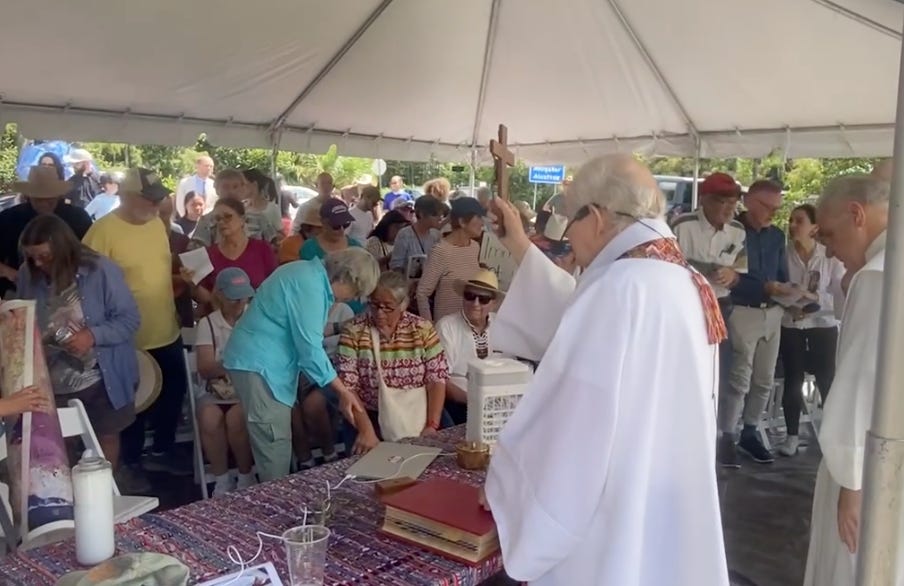
At the start of the service, Blanco told the crowd she was able to make contact a day or so earlier with a detainee from Lake Worth Beach.
“I mentioned to him we would be hosting this Mass a mile away from their facility,’’ she told the crowd, “so the people being detained are aware we are holding this Mass right now and are praying with us so we really are praying in solidarity with them.’’
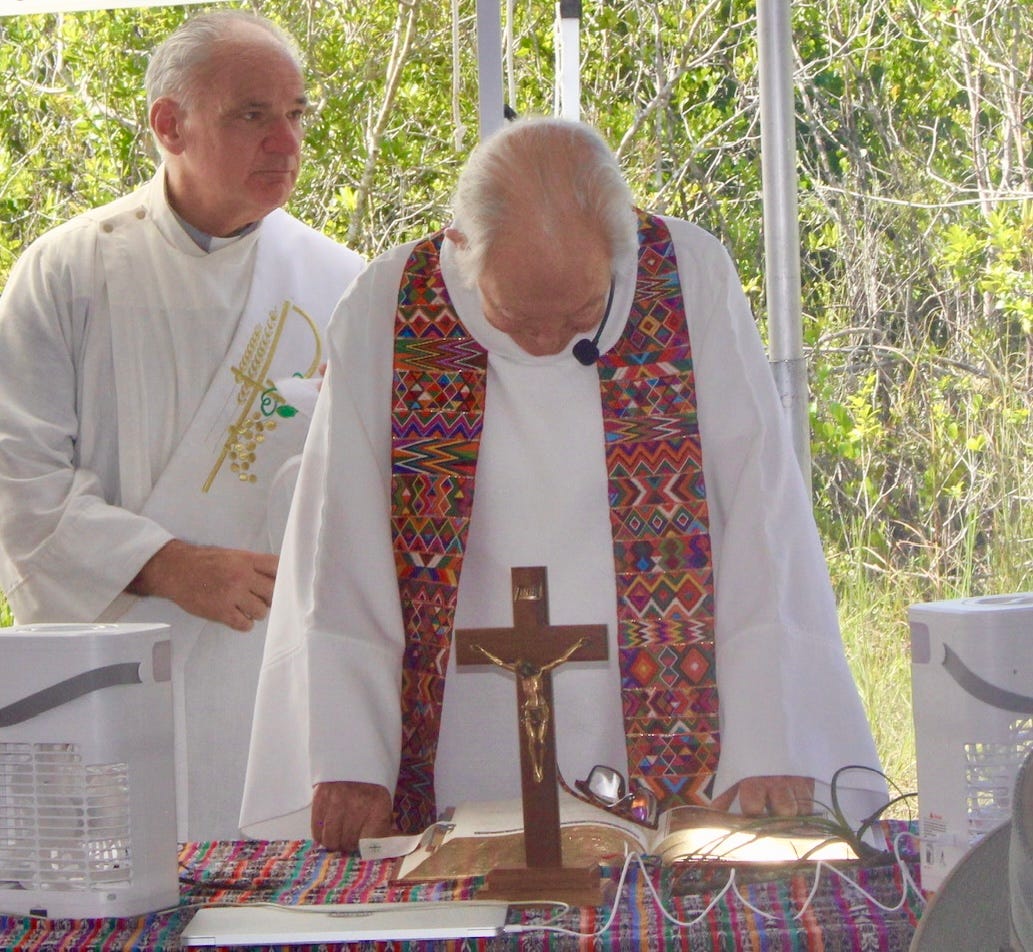
Like the rock star that many consider him, Father Frank wore a microphone headset. Speakers were set up around the tent. A table turned into a makeshift altar with a Bible, prayer books, candles, oils, communion wafers, sacramental wine.
Also in the tent: Bug spray, portable fans, mist sprayers, coolers with bottled water.
After a passing truck interrupted the service with a long blare of the horn, Father Frank asked the crowd: “Have you said a prayer for the unfortunate people who have allowed (themselves) to be so misguided these days? We have the simplest commandments imaginable: Love your father, love your mothers …”
When the service ended, a fellow priest said out loud, “Thank you, Father Frank,’’ prompting congregants to erupt in applause.
A few minutes later, Kay marveled at how his old friend shined in what many might consider an inhospitable setting for a frail 83-year-old with a bad heart.
“Some people,’’ he said, “you put them on their stage, in their pulpit, and as weak and frail as they may be, they gather their strength and just become the message or the song, or the prayer comes out. And he is one of those people who can do that and still inspire people. He’s quite amazing.’’
 | A guest post by
|
Thank you for reporting this
This is great reporting, a piece with strong LWB connections you might not hear about on the national news. Thanks, Joe!!