
'Lake Worth Beach is not a free-for-all anymore’ — New rules would ban Bryant Park food sharing
Advocates for the homeless threaten legal fight if city commissioners approve permitting restrictions on Jan. 20

UPDATE: City Commissioners on Jan. 20 agreed to postpone a final vote until Feb. 3, 2026.
As the historic Gulfstream Hotel prepares to re-open later this year after a multimillion dollar renovation, Lake Worth Beach’s elected leaders are expected to approve controversial permitting rules that will clear homeless people from Bryant Park, the public waterfront space next to the hotel.
An ordinance scheduled for a final vote Tuesday night would strictly regulate “free food handout events” in public places by requiring food-sharing groups to get permits, insurance and state health certificates. The ordinance would also restrict the handouts to three public locations: Memorial Park, Howard Park and Sunset Ridge Park.
Advocates for the homeless, including a group that fought similar measures in West Palm Beach and Fort Lauderdale with varying degrees of success, are threatening to challenge the new rules in court.
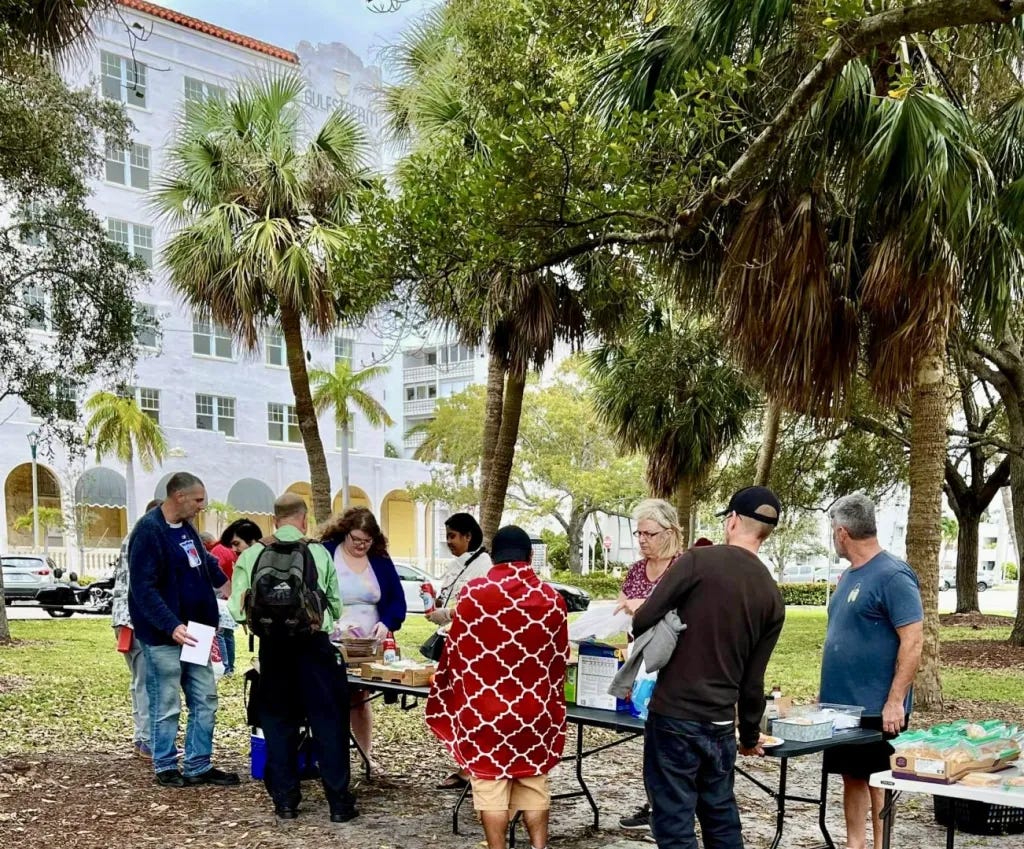
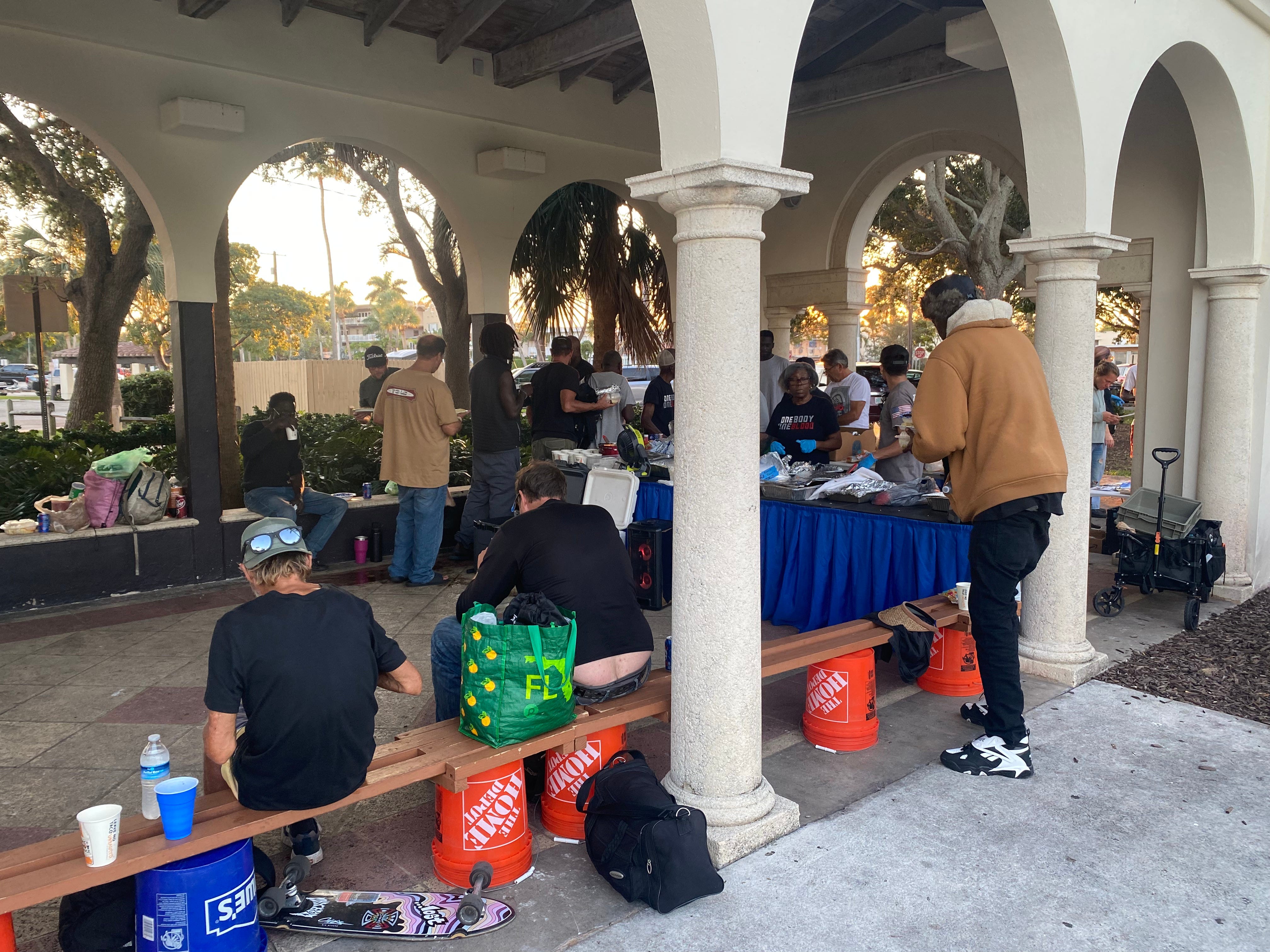
The food-share rules were drafted after residents and visitors complained they don’t feel safe in Bryant Park. City officials said the park has become a hangout for the homeless because, among other reasons, unhoused people know they can get free food there at least four times a week.
Commissioners have said they were told other cities were sending their homeless people to Bryant Park on Palm Tran buses. The city is spending $98,000 to repair toilets, sinks and other amenities destroyed by vandals at South Bryant Park. And some downtown businesses have complained about people defecating on sidewalks.
“This isn’t about us being heavy handed. This is about making sure food is passed out the right way,’’ Vice Mayor Sarah Malega said Jan. 6 when commissioners endorsed the rules on first reading.
“Lake Worth Beach is not a free-for-all anymore. It’s that simple,’’ said Malega, who has said she was once homeless.
The law firm that contracts with Lake Worth Beach for city attorney services, Torcivia, Donlon, Goddeau & Rubin, drafted the rules after reviewing court rulings on similar measures enacted over the years in West Palm Beach and Fort Lauderdale.
“We can learn from those cases … and write it in a way that allows the activity,’’ attorney Christy Goddeau told commissioners last spring. “We want to treat it as a protected activity for purposes of avoiding a lawsuit.’’
Fort Lauderdale was ordered a few years ago to pay $640,000 in legal fees to lawyers for Food Not Bombs and four other groups who successfully challenged the city’s 2014 food-share ban, which has since been repealed.

Some advocates for the homeless said Lake Worth Beach can expect a court fight if the new rules are approved.
“We are collectively organizing and we will pursue legal action,’’ said Melissa Salerno of Palm Beach & Treasure Coast Democratic Socialists of America, which collaborates with Lake Worth Food Not Bombs to share hot meals with homeless people in Bryant Park every Thursday at 5:30 p.m.
Commissioner Chris McVoy has been the city’s only elected official to push back on the proposed restrictions, which would limit food handouts per group to twice a year.
“There is a subset in this community that just doesn’t want to see people who are less fortunate, and I think that’s pretty despicable,’’ he said Jan. 6.
“Face up to it, people on this commission,’’ he said. “Let’s call spade a spade. This is codifying ways to make it harder to be nice to people who have less. And if you all think that’s a really nice thing to do, go ahead and vote for it. I’m not voting for it.’’
The food-sharing restrictions are among broader changes to permitting rules for “special events” of different sizes at parks and other city property. Mayor Betty Resch said commissioners might tweak some of the proposed rules before taking a final vote.
Stuart Sword, the city’s assistant director of leisure services, said the three pavilions listed in the draft ordinance were chosen in part because of their proximity to public transportation, an effort to make it easy for homeless people to get there.
“But you’ve never carried your house on your back and or perhaps have had a disability,’’ Salerno said in an interview. “Maybe you don’t have proper footwear. There are a million variables that people living in positions of privilege don’t really consider. People are hungry more than twice a year.’’
Food shares are offered downtown seven days a week, including four days at Bryant Park, according to a printed schedule shared by advocates for the homeless. (See the schedule by clicking here and here.)


Other food-share sites are the city-owned Compass Community Center and three churches, including Common Ground Church at 1201 S. Federal Highway, where food is offered four days a week.
Groups that share food at Bryant Park have already taken steps to find new distribution sites.
“I’ve been telling people for almost a year to find some private property to utilize for their events like I have at Common Ground,’’ said Randy Lewis of the Lake Worth Burrito Project, which has reduced its food-shares in Bryant Park to once a week, a Sunday morning bag breakfast.
“I could see the writing on the wall when they started doing all the high end plans for that hotel,’’ he said. “They don’t want (hotel patrons) to look out their thousand- dollar-a-night window and see people feeding the homeless.’’
The new Gulfstream Hotel will be part of the Marriott Bonvoy brand. Although the hotel’s owner is aiming to open by April 1, the earliest available booking on the Marriott website is July 5, with a $462 room rate.
There has been loose talk by some homeless advocates of protesting the Bryant Park food-share ban in front of the hotel after it opens.
“Food is a human right,’’ Hannah Perle, Burrito Project volunteer told commissioners Jan. 6. “Your fancy hotel should not stop us from doing our mission, which is serving others. Hiding your problems is never the answer.’’
Tashia Gibbs of The River Fellowship church, whose volunteers offer food at Bryant Park every Saturday, said the church will probably look for a new location.
“If they put a law in place, we are going to follow the law,’’ Gibbs said one day last month as people lined up in the Bryant Park pavilion for plates of pasta.
“I get it. They are putting millions of dollars into the hotel. They want people to feel welcome and they want people to spend money in the city,’’ she said. “As a resident I can understand their perspective. But as someone who serves the poor, I understand the pain of these people, too. They need some place to go to provide for their needs and the city really is not answering that nor are they providing anything.’’
This story was updated at 11:45 p.m. on Jan. 20 to reflect the commission’s decision earlier that evening to delay a final vote until Feb. 3.
Concerning food sharing in Lake Worth Beach. This was shared at the January 20th Commissioners meeting.
Good evening, Mayor, Vice Mayor, and Commissioners.�My name is Mike Olive. I am a resident, business owner, and pastor in the City of Lake Worth Beach.
I understand the complexity of the vote before you this evening, and I do not envy the responsibility that comes with the leadership entrusted to this body.
I respectfully ask that tonight’s decision be approached with both thoughtful judgment and compassion—head and heart together.
The decisions made this evening will affect many of our neighbors. Most of us in this room will return home tonight to warmth and food security. Many in our community will not.
I would like to ask whether it is possible for the City to form a partnership with local nonprofit organizations that are committed to serving the less fortunate in our city. Is there room for a collaborative approach that reflects both responsible governance and human care?
I have listened to each of you speak on this issue, and I am convinced that every member of this board cares deeply about Lake Worth Beach. My concern is not only about tonight’s vote, but about what follows.
Rather than taking a vote and moving on from a problem that remains unresolved, could city government and local nonprofits begin to work together after this decision to seek solutions that serve the entire community?
I believe that by becoming partners in creative problem-solving, we can avoid an adversarial relationship and instead build one rooted in cooperation and mutual respect.
This is a passionate issue, and understandably so. What I am respectfully asking of the board tonight is compassion—expressed through collaboration and a shared commitment to finding solutions that bring hope and dignity to all residents of our city.
And perhaps, through that effort, Lake Worth Beach can be known as a city where head and heart come together—moving hands toward meaningful solutions.
Thank you for your time and for your service to our community.
Move the food sharing to the Drive -in on Lake Worth Road where it's out in the open. Bryant Park is not safe anymore. I used to walk my dog there but the harassment and pan-handling was overwhelming.